
Investments in major new construction and redevelopment projects from the central business district out to the suburbs signal investor opportunity.
By Jason Stevens, Lument
It has been 12 years since Detroit, having lost more than a quarter of its population between 2000 and 2013 and seen its tax revenues plummet, became the largest U.S. city to declare bankruptcy. The city endured decades of hardship, and many neighborhoods struggled with vacancy until recent revitalization efforts began to take hold.
Today, Detroit’s turnaround is well underway. Government finances are on a firm footing, city services have been restored, and the city’s population is growing.(According to the U.S. Census Bureau, the city gained nearly 7,000 people from July 1, 2023, to July 1, 2024. More specifically, the city’s population rose from 638,914 to 645,705, an increase of more than 1 percent.)
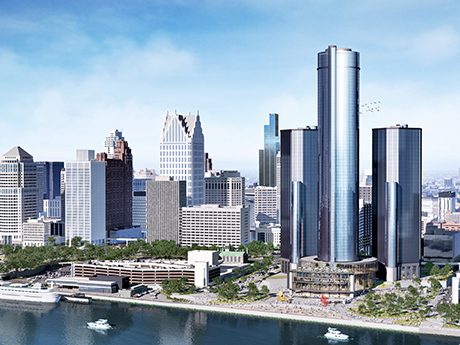
Downtown revitalization, marked by such projects as the Detroit River waterfront redevelopment and the transformation of the Michigan Central Station into a tech and culture hub, has begun to seep into surrounding neighborhoods. Though much remains to be done, Detroit is clearly on the upswing.
Conversions and New Development
Multifamily development has been a big part of this revival. Investors have found Detroit’s many historic office buildings to be the perfect structures for multifamily conversions. These have included the Albert Kahn Building, the Detroit Free Press Building and the Book Tower. But there has also been a resurgence in new construction.
When it opened in 2023, the Exchange, a 16-story luxury high-rise in Greektown, was the first newly built residential high-rise in Detroit in years, and the Residences at Water Square, erected on the riverfront site of the Joe Lewis Arena, joined it in 2024.
The city has emphasized mixed-use development. The recently opened City Modern complex epitomizes this priority. Spanning 8 acres in Brush Park, it combines retail, condos and both market-rate and affordable rental housing.
Detroit has also made affordable housing a priority. Recent examples include the Cathedral Arms in Midtown and the Transfiguration School — both developed in conjunction with the Archdiocese of Detroit — and the Orchard Village Apartments in the Old Redford neighborhood.
The city has established a series of programs, including the Detroit Housing for the Future Fund and its Payment in Lieu of Taxes (PILOT) policy, to encourage affordable development, especially projects rehabilitating long-vacant properties.
Performance, Yield Draw Investors
Developers delivered approximately 2,500 new multifamily units across the Detroit metro in 2022, followed by 2,000 in 2023 and 1,500 in 2024, according to Yardi Matrix, with a similar volume expected in 2025. This pace of construction leaves Detroit well short of the oversupply pressures seen in many Sun Belt markets. Within the city of Detroit, however, the housing stock has been shrinking for decades — including the loss of more than 20,000 rental units between 2000 and 2010, according to ULI — so today’s deliveries signal that the market is beginning to turn a corner as the city’s apartment inventory slowly rebuilds and expands.
Detroit’s supply-demand dynamics are shaping its fundamentals. As of the third quarter of 2025, Yadi Matrix pegged annual rent growth in Detroit at 2.2 percent (in the top 10 for all U.S. markets) with an overall occupancy rate of 94.8 percent, 20 basis points above the U.S. average.
This solid performance has meant that investors, especially those who have soured on overbuilt Sun Belt markets like Austin or Phoenix, are giving Detroit a fresh look. While other Midwest cities like Columbus, Indianapolis and Minneapolis have seen more interest, investors have been impressed by Detroit’s solid decade of progress and growing momentum.
The yields are attractive. Cap rates average 5.8 percent through the third quarter of 2025 according to MSCI, up 20 basis points from 2024 and 60 basis points from 2023. Still, these rates are much lower than those recorded over the previous two decades and signal the increasing appeal of the Detroit market.
Although transaction volume remains well below record highs, total 2024 sales volume increased more than 60 percent between the third quarters of 2024 and 2025, with some sellers showing more flexibility than in the recent past.
Recent transactions include the 588-unit Crossroads in suburban Southfield, which sold for $83 million, and two communities along the I-275 corridor in Westland; the 192-unit Turtle Cove Apartments that sold for $27 million; the 264-unit Hines Park Apartments that traded for $22 million; and the 152-unit Alcove Troy that changed hands for $15.5 million.
Outward from the Center, Inward from the Suburbs.
The revival of Detroit continues. Bedrock, the real estate firm that has poured $7 billion into downtown Detroit since 2011, is the driving force behind Hudson’s Detroit, a mixed-use development, located on the site of the former J.L. Hudson’s flagship Store.
The newly completed project incorporates retail, office, event space, residential units and a five-star hotel. General Motors will be relocating its global headquarters to the high-rise tower at the heart of this project.
Bedrock has also teamed up with GM on a $1.6 billion plan to redevelop Renaissance Center, GM’s current world headquarters. The plan includes demolishing two office towers, removing the podium that walls off the complex from the river, and redeveloping three other high-rises to provide a mix of residential and hospitality space.
In the meantime, several multifamily communities are scheduled to open in 2025 and 2026 in central Detroit. These include the Preserve on Ash in downtown, a 69-unit mixed-income community in the Corktown neighborhood. The first building of the Henry Street Apartments is on track to open in 2026. Located in District Detroit, the city’s sports and entertainment center, this project entails the conversion of seven historic buildings into 170 residential units, with half designated as affordable.
The suburbs are also seeing activity. The redevelopment of the former Northland Mall site in Southfield, a northeast suburb, will generate a stream of multifamily housing over the next few years. This redevelopment will encompass 97 acres and include more than 1,500 apartments alongside retail, dining, and entertainment options. A second Southfield project, with 577 workforce apartments, has just received $132 million in Transformational Brownfields Plan funding from the Michigan Strategic Fund.
Detroit Mayor Mike Duggan, who took office in 2013, is widely credited with marshalling the coalitions that have made the city’s revival possible, focusing on the downtown and the Midtown neighborhood. This year he stepped down in order to focus on the 2026 Michigan gubernational race.
In his place, Mary Sheffield, a longtime city council president, won the Nov. 4 mayoral election in a decisive victory and became Detroit’s first female mayor. Although Sheffield comes from a platform distinct from Duggan’s, she and her incoming team broadly agree on the next phase of Detroit’s renaissance: moving redevelopment beyond downtown and Midtown into the communities between the core and the suburbs.
For investors focused on Detroit’s trajectory and growing momentum, that continued emphasis on multifamily housing outside the downtown area signals opportunity.
Jason Stevens is managing director, real estate investment sales, at Lument.