

Multifamily owners are facing sharply worsening capital conditions even as market fundamentals have changed relatively little, according to the National Multifamily Housing Council’s latest Quarterly Survey of Apartment Market Conditions, released Oct. 22.
NMHC’s quarterly survey evaluates the multifamily sector across four benchmarks: market tightness, which reflects changes in vacancy and rent conditions; apartment sales volume; equity financing availability; and debt financing conditions. In practical terms, a tighter apartment market generally means lower vacancies and stronger rent growth, while a looser market generally means higher vacancies and weaker rent growth.
An index below the breakeven level of 50 means more respondents reported deteriorating or, in the case of the apartment market, loosening conditions than improving or tightening conditions.
The third-quarter results released in Octoberreveal a stark divide between property performance and the capital markets. NMHC’s debt-financing index fell to 10 from 46 in July, while the equity financing index declined to 17 from 44. The sales volume index dropped to 22 from 46.
By comparison, the market tightness index declined more modestly, to 47 from 57. More than half of respondents, 53 percent, reported no change in apartment-market conditions, while 26 percent reported looser conditions and 21 percent reported tighter conditions.
The survey of 130 CEOs and other senior executives at apartment firms found that 81 percent considered October a worse time to borrow than it was three months earlier, while 61 percent reported declining apartment sales volume.
Refinancing also remains a concern. Sixty-one percent of respondents said lender debt-service-coverage or loan-to-value requirements were preventing them or their clients from refinancing the full amount of some maturing loans.
What’s Behind the Capital-Market Disconnect?
Multifamily & Affordable Housing Business asked Chris Bruen, NMHC’s senior director of research and chief economist, to explain why financing conditions have deteriorated much more sharply than apartment fundamentals and what could spur transaction activity to get moving again.
MAHB: why did financing conditions worsen so substantially over the past three months?
Bruen: NMHC’s Quarterly Survey indexes show which direction respondents feel conditions are moving, but not how much they have changed. A Debt Financing Index of 10 means that far more respondents (81 percent) said borrowing conditions worsened from three months earlier than those who said conditions improved (2 percent). It does not necessarily mean respondents thought conditions became dramatically worse; rather, there was widespread agreement on the direction of change.
The main reason borrowing conditions deteriorated appears to be the increase in the U.S. 10-year Treasury yield, which rose 81 basis points from 4.48 percent on July 1 to 5.29 percent on Sept. 30. (The 10-year yield has since retreated, closing at 4.84 percent on Nov. 5.)
MAHB: If Treasury yields came down, would that be enough to materially improve financing conditions?
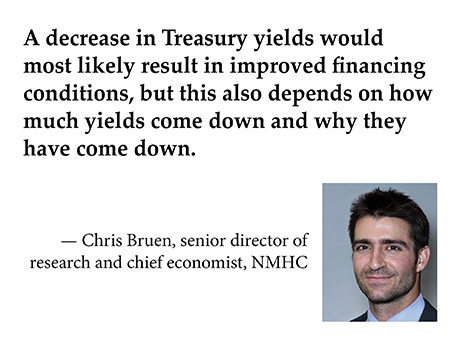
Bruen: A decrease in Treasury yields would most likely result in improved financing conditions, but this also depends on how much yields come down and why they have come down. For example, if yields decrease because economic growth meaningfully slows or we enter a recession, lower interest rates might not be enough to draw in lenders and investors while fundamentals are weakening. On the other hand, if yields decrease because inflation comes down, financing conditions would almost certainly improve.
MAHB: If apartment properties are performing relatively well, why isn’t that enough to get more transactions moving? Can good fundamentals eventually matter enough to break the stalemate?
Bruen: Conditions for debt and equity financing worsened largely due to the recent increase in interest rates, which does not have much of an immediate impact on occupancy or rent growth.
Fewer properties are changing hands mainly because buyers and sellers can’t agree on price. Given the recent rise in interest rates combined with weak rent growth, potential buyers are looking for lower prices, which owners are often unwilling to accept.
Improved property fundamentals could entice buyers to pay something closer to what sellers are asking, which would get more deals moving.
Access to capital will always be a limiting factor as well. A decrease in long-term interest rates could similarly close the gap between what buyers want to pay and what sellers want to get, leading to more deals.
Finally, absent any changes to financing conditions or property fundamentals, a prolonged period of lower economic volatility — including fewer swings in interest rates — should help buyers and sellers come to terms on prices.
MAHB: What indicators are you watching for evidence that the multifamily capital markets are beginning to loosen again? What would need to change for owners, lenders and equity investors to become more active?
Bruen: We’re watching Treasury yields and inflation closely. If yields come down because inflation eases, financing conditions would almost certainly improve. We’re also watching rent growth and occupancy, since improved property fundamentals could translate to more buying and selling. However, even without any improvement in fundamentals or financing conditions, lower volatility in interest rates and other economic conditions could allow pricing to adjust and sales to pick up.
Our quarterly survey indexes will also show whether respondents feel conditions are starting to turn.
— Lynn Peisner