


By Nellie Day
It started as a convenience, but now it’s an expectation. Yes, we’re talking about online shopping — or more accurately, the mound of heavy, oddly shaped and ever-delivered boxes that unite multifamily residents with their latest e-commerce obsession.
Once considered a tedious operational task, package management has become a daily — sometimes hourly — balancing act between service, space and sanity.
Residents expect the same fast, efficient experience they get from Amazon, while owners and managers are left to pick up the pieces, or rather the packages, that litter their communities.

“Residents now expect delivery access, speed and convenience to match what they’re used to from retail,” explains Myka Staryk, regional vice president of Orlando, Florida-based ZRS Management. “Apps like Amazon and Walmart have set the bar by sending real-time notifications, photos and ‘driver en route’ alerts.”
This service expectation is often transferred to on-site staff, Staryk adds, since many residents assume all packages are funneled through the property, especially those that include a package-handling fee in the monthly rent.
“Residents hold management accountable for ensuring their deliveries are seamless, whether that means secure storage, driver quick access or straight-to-door delivery,” continues Staryk.
The result is a collision between expectations and infrastructure as multifamily communities handle this ever-increasing volume of packages with limited space, staff and budgets. And the hard truth is this package problem will only get worse.
Feeling Overwhelmed
Package volumes at multifamily communities are up nearly 150 percent since 2015, according to HelloPackage, an on-site package management solutions company based in Peachtree Corners, Georgia, approximately 23 miles northeast of Atlanta.
Kelli Stuart, general manager and assistant vice president at property and financial services company Draper and Kramer, knows this all too well. Her 740-unit community, located at 1350 N. Lake Shore in Chicago, receives more than 5,000 packages each month.
“The sheer volume of packages coming into properties on a daily basis is what makes package management so challenging,” she says.
Smart Package Room is tracking similarly eye-popping numbers. The Portsmouth, New Hampshire-based secure package solutions provider notes the average 400-unit apartment building in New York City receives about 187 packages a day. That number jumps to 208 during the holidays.
Shelly Peterson, vice president of Smart Package Room, thinks she knows why these numbers have skyrocketed. First, there is the onslaught of incentivized online shopping days. This includes everything from the traditional holiday shopping period to off-season sales events like Prime Days (now four days long), Best Buy’s Black Friday in July, and Target Circle Week in the summer and fall.
“Add to that the proliferation and popularity of direct-to-consumer convenience
categories among Gen Z and millennials, from niche fitness equipment like Peloton and Tonal, to discount mattress brands like Casper, Purple and Helix, to meal plan delivery services like Blue Apron and HelloFresh, plus free or discounted shipping offered by Amazon and major retailers,” says Peterson.
“As residents search for their first or their next multifamily property to call home, these digitally native consumers have come to expect a secure and quick package delivery service for all of their items, even large or oversized ones,” adds Peterson.
The younger cohorts aren’t the only ones barking “Where’s my package?” at both their Alexa-enabled devices and the front desk staff.
Research from HelloPackage shows that 85 percent of renters say package convenience influences their leasing decisions, while one in five renewals are swayed by amenities like seamless package handling. With this kind of information, the onus becomes obvious.
“Package management is part of a property’s core infrastructure,” says Nicola Kiser, director of revenue operations at HelloPackage. “Not addressing it costs money in staff hours, lost renewals and package theft, which accounts for over $6 billion in losses annually.”
Deliveries Pile Up
Although there are many problems that can come with delivering hundreds of packages to hundreds of units, Peterson sees one issue rising above the rest.
“Waves of daily incoming packages just won’t stop,” says Kiser. “Delivery drivers from Amazon, the United States Postal Service, UPS and FedEx haul large carts full of packages of all shapes and sizes through the lobby doors all day long, often returning multiple times in a single day.”
If staff can’t respond to the couriers’ immediate needs, or when the dedicated package system reaches capacity, the results can be chaotic.
“It leads to an unsightly mess of packages left outside of secure zones — on the floor, on decorative tables, clogging up hallways or dropped off at the front desk,” states Peterson.
Ermin Husic, community manager at Habitat’s Cassidy on Canal in Chicago, confirms that his property is constantly hit with the trifecta of volume, capacity and carrier requirements.
“The number of packages — especially oversized deliveries like furniture — has exceeded what traditional locker systems can handle,” he says. “Items such as headboards, nightstands, desks and sofas now arrive regularly and require significant space.”
Rethinking the Logistics
Laura Khouri, president and COO of Irvine, California-based Western National Property Management, notes frequent furniture deliveries have caused her communities to think outside the box, pun intended.
“Parcel lockers were never designed for a sofa, so we’ve had to rethink space and logistics in ways that weren’t on our radar a few years ago, along with significant handling care,” according to Khouri.

Part of the solution has been reallocating underused spaces. This approach has included converting an outdated leasing office into a delivery space for packages, then transforming a rarely used clubhouse building into an updated leasing office. “We work creatively within the existing space,” emphasizes Khouri.
ZRS has done the same. The property management firm repurposed a room within one community’s clubroom amenity space into a package center, adding Butterfly MX for access and hiring an attendant for service and security.
Even with the extra payroll, Staryk notes ZRS still saves money versus using a third-party package management provider.
“As a bonus, the added staff doubled as an evening clubroom attendant, which provided the residents with much-desired evening amenity space access,” she adds. “This enhanced the resident experience and still drove a profit for the asset from package management fees.”
Making do with what you have and saving where you can be prudent strategies in today’s high-cost environment. But not everyone’s a fan. To some, overflow rooms are an eyesore at best and a Band-Aid on a bullet wound at worst.
“With every square foot representing significant cost to the project, hitting the ‘just right’ amount of area [for package management] can be a challenge,” admits Brad Lutz, managing principal of the Chicago office and practice leader for the multifamily division of Baker Barrios Architects. “We tend to advise on carving more space than you think you need.”
Deana Cimorelli, national account executive at Fetch, an off-site package management solutions company, also isn’t enamored with this solution.
“Communities panic and throw band-aids at the problem without thinking it through,” she says. “They see packages piling up and immediately think, ‘We need more lockers,’ or ‘Let’s make the package room bigger.’”
She sees two problems with this approach. The first is that any on-site solution requires carrier cooperation to work properly.
“If the carriers are not scanning packages or aren’t taking the time to place them on shelves or in lockers, the staff has to step in to actually make use of those solutions,” explains Cimorelli.
The second problem is that expanding physical space to handle more deliveries is only a temporary fix. “Package volume continues to grow, so when communities expand their existing package solution, they are really just buying time, not solving the issue,” she notes.
“We have had multiple communities come to us within 12 to 24 months of installing or expanding on-site package solutions because those solutions either aren’t working or they have once again run out of space. The real fix isn’t about cramming more packages into your building, it’s about getting them out of your building entirely,” adds Cimorelli.
Door Deliveries Win Over Residents
Fetch does this by delivering packages directly to residents’ doors from its off-site warehouse, removing the community’s on-site team from the equation. Staryk sees the value in services like this, which generally charge a fee that is passed along to residents.
“Deliveries to the door will always be the residents’ preference,” declares Staryk. “People don’t order 50-pound bags of dog food then expect to lug them from the locker to their unit. They want it to land as close to Fido’s bowl as possible.”
Patti Higgins, senior vice president at Parktown Living, a boutique property management company in Woodland Hills, California, concurs that residents want packages delivered to their door. She also agrees with minimizing on-site staff’s involvement with these packages. However, this has led her to a different solution — one that may be the most basic of all.
“Ultimately, we’ve found that keeping it simple — allowing deliveries to go straight to the resident’s door — has been the most effective solution for both operations and resident satisfaction,” she says. In other words, no third parties and no sorting from on-site staff.
Higgins clearly favors a back-to-basics approach, but others believe automation can achieve that same simplicity without the revolving door of drivers, or runaway costs.

“For owners concerned about budget, we recommend a scalable, subscription-based solution,” says Kiser. “HelloPackage requires no upfront capital expenditure and clients can start small. We layer in AI driver management, proactive customer success prep and optional on-site labor, ensuring even limited budgets get maximum benefit,” explains Kiser.
“We also provide guidance for staff on how to handle system gaps and driver non-participation, making sure the property isn’t left exposed.”
Hybrid Strategy Emerges
Staryk may know what residents want (direct-to-door delivery), but she also recognizes that communities face practical limits in making that a reality. That’s because handing off a package to residents is rarely a hands-free process, no matter how much managers wish it were.
“The hardest truth is that there’s no such thing as ‘staff-free’ package management,” she says. “Every system, be they lockers, package rooms or third-party services, still requires human intervention. Accepting this [reality] upfront and planning staffing models accordingly has made a huge difference in resident satisfaction.”
Staryk recommends a hybrid strategy, one where deliveries to the door are a priority, but overflow package rooms and designated staff hours for intervention serve as safety nets.
In an interesting twist, lockers — once considered the cornerstone of any package management system — are being phased out by some apartment buildings. The reasons usually center around cost and inadaptability.
“One mistake some property managers make is investing in a hardware-heavy solution that requires fixed square footage within their building,” cautions Peterson. “Lockers, for example, are inflexible. They feature pre-set storage compartments and are required to be placed along existing walls. As a result, they fail to maximize the number of packages per square foot that they can store, resulting in overflow packages, including larger boxes, often containing more valuable contents, left unsecured.”
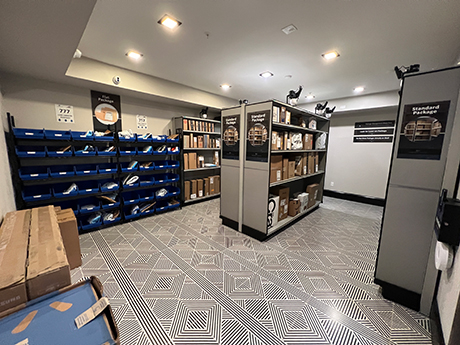
Many property managers believe there is a better storage system out there today. “Shelving instead of lockers,” says Husic. His Cassidy on Canal community utilizes a shelving-based Smart Package Room where lasers guide recipients directly toward their packages. This change has made the “biggest positive impact” on residents, he notes.
“While lockers are convenient, they are space-inefficient since one small package can take up a large locker,” says Husic. “By removing the constraints of locker sizes, we’ve significantly increased capacity and efficiency.”
Husic adds, however, that no system is perfect. Lockers, for example, are limited in capacity but easy for carriers to use. Shelving, on the other hand, expands volume but requires more oversight and training.
“The biggest ongoing challenge is carrier adoption and consistency,” according to Husic. “Regular drivers typically learn the system quickly, but when routes change or contract drivers are used, retraining becomes necessary. This inconsistency creates inefficiencies and requires ongoing staff attention.”
This problem seems to occur regardless of the community, budget or package management option. Khouri notes miscommunication with delivery drivers was a major pain point for her organization until they created a clear system and communication channels.
“If we could go back, we’d implement courier training and post-delivery instructions sooner,” she admits. “It’s a small investment that pays off during peak times like the holidays.”
Stuart also cites coordinating with carriers as one of Draper and Kramer’s biggest challenges surrounding seamless package delivery. “At some of the properties I oversee, packages are dropped off to us in bulk — sometimes 200 packages or more at once — and the carriers have us sign once for the entire shipment, rather than wait for us to verify and sign for each individual package.”
Effective Package Management Involves a lot of Trial and Error
Even with smarter systems, hybrid approaches and more flexible layouts, package management will continue to demand equal parts strategy and adaptability.
“Because every community has different layouts and resident behaviors, the challenges vary,” says Myka Staryk, regional vice president of ZRS Management based in Orlando, Florida. “What works at one site can quickly unravel at another.”
The right package management solution doesn’t just involve a building’s space. It also depends on the renter demographic.
“The conversation does change depending on what kind of property we’re talking about,” notes Deana Cimorelli, national account executive at Fetch, an off-site package management solution company. “High- or mid-rise residents in higher-class buildings in downtown areas want that concierge-level service.”
These communities differ from garden-style or mid-rise communities, she adds, where controlling costs and minimizing staff burden are more important.
No matter the strategy or renter demographic, the need for on-site oversight will always be there, according to Laura Khouri, president and COO of Irvine, California-based Western National Property Management.
Staryk’s advice is to dedicate a few hours each week to managing overflow packages that don’t fit into a designated package area.
HelloPackage helps owners by ensuring drivers are compliant with their communities’ package policies. Nicola Kiser, director of revenue operations, sees this as an important component of any third-party service. Because she’s seen what can happen when delivery expectations falter.
“Leasing and concierge teams spend an average of four to six hours per week handling packages, over 300 hours per year, which pulls them away from revenue-generating work,” she explains.
“Delivery drivers often don’t follow the intended workflow, leaving packages in the wrong place or bypassing the system entirely, which creates extra work and frustration for staff.”
Staff members are often left not only to deal with the added workflow, but with unhappy residents likely to point fingers over damaged or missing packages.
“Our AI delivery driver management encourages carriers to follow the workflow correctly, reducing package dumps in the office,” says Kiser. “And when drivers don’t participate as expected, we provide on-site labor support and best-practice guidance, so staff aren’t left picking up the slack. One community saw staff-handling time drop 80 percent and package complaints disappear within the first month.”
Leveraging Technology Pays Off
Removing staff from the package process doesn’t just save time, it saves money. Kiser points out that a 300-unit property can save $12,000 to $18,000 in annual payroll alone when packages are automated.
“The highest ROI (return on investment) comes from removing staff from package handling,” she notes.
According to Fetch, initial installations of entry-level locker systems cost between $6,900 to $20,000 for hardware, not including any fees associated with maintenance, staff time or software needed to manage the system.
Vendors don’t publish a universal rate card because costs vary widely depending on factors such as where the property is located, the unit count and service model. Costs also vary by owner strategies. Some charge an upfront, bundled, one-time amenity fee that includes services like package management, valet trash service, pet amenities or Wi-Fi.
Metrics moved in the right direction at Stuyvesant Town in New York City, which installed Smart Package Room’s system to handle its 1,000-plus daily packages for its 30,000 residents.
Yes, you read that right. At 80 acres and more than 11,200 units, Stuyvesant is America’s largest apartment community. During peak times, residents previously waited for up to 30 minutes to receive their packages, which were sorted daily by 12-plus staff members.
“Resident wait time plummeted over 600 percent, to just seconds,” says Shelly Peterson, vice president of Smart Package Room. “As a result of the automated delivery and pickup processes — plus the ability for residents to access the secure room 24/7 — they were able to reduce the number of full-time staff managing package duty from 12 to two.”
Of course, efficiency isn’t just about process. It’s also about place. Even the best technology can’t solve a space that wasn’t designed to keep pace.
Brad Lutz, managing principal of the Chicago office and practice leader for the multifamily division of Baker Barrios Architects, argues that the physical layout of a community can make or break even the most organized package system.
“We’ve had to adjust to this new frequency and respond with more intentional design solutions to make sure we’re paying attention to how the space not only functions, but how it looks and feels if it’s going to be a place residents experience daily,” he says. “Gone are the back hallway afterthought spaces.”
They have been replaced, he notes, with thoughtfully designed and curated spaces that are just as detailed as a building’s other amenities. Think lockers painted with murals and perishable deliveries stored in glass-front refrigerators.
Do’s and Don’ts
Access and visibility are also key. When building a community from the ground up, Lutz recommends adding a space that can seamlessly incorporate package lockers.
“Resist the temptation to leave it a standard color and instead look at it as another canvas that can help it to blend into the overall aesthetic of the building,” he says.
“Don’t treat it like a back room. It’s inexpensive to use paint, simple murals and thoughtful lighting to liven up these spaces that residents see on a regular basis.”
He also likes to add thoughtful touches, such as counters, sofas, and bins for trash or recycling for those who want to open their package right away (or not bring the trash into their unit).
In addition, Lutz sees the value in a separate large package/overflow room that has direct access to the exterior.
“That way, items being carried in and out can be banging up a dedicated package door — not dinging or damaging your leasing and lobby finishes,” he continues.
Ermin Husic, community manager at Habitat’s Cassidy on Canal in Chicago, agrees with the proactive design approach.
“With more residents ordering boxed furniture online, oversized items now make up a large portion of our package volume and often fill the oversized room,” he says. “Designing storage solutions that anticipate this trend, rather than retrofitting after the fact, saves time and resources.”
Staryk knows this lesson too well. “If I could redesign all our buildings, every apartment would have a dedicated package door,” she says. “Until then, layering tech, human support and flexible space is the most resilient approach.”
— Nellie Day