

By Matthew Auchincloss
The dire need for more affordable rental housing across the country has been well-documented, but the pathway to delivery is full of potential pitfalls, says Ian Hunter, regional director at Dwell Design Studio, who operates out of the architectural firm’s Atlanta office. In short, there are several ways for projects to “get stuck,” he points out.
At the top of the list is funding, but the entitlement process, design, construction costs and operations are also potential impediments to getting an affordable housing project from conception to inception.
Editor’s note: InterFace Conference Group, a division of France Media Inc., produces networking and educational conferences for commercial real estate executives. To sign up for email announcements about specific events, visit www.interfaceconferencegroup.com/subscribe.
“It is a very long development cycle,” says John Hundley, Atlanta studio director at Rosemann & Associates, which specializes in multifamily, affordable and seniors housing. “A lot of times when we’re getting involved with an LIHTC (Low-Income Housing Tax Credit) project, it’s 12 to 24 months … and a lot can change during that whole time.”
Hundley’s insights came during a panel on design at InterFace Affordable Housing Southeast, a half-day event that took place on Tuesday, May 12, at The Westin Buckhead in Atlanta. Multifamily & Affordable Housing Business, Southeast Real Estate Business and InterFace Conference Group, a division of Atlanta-based France Media Inc., co-hosted the event.
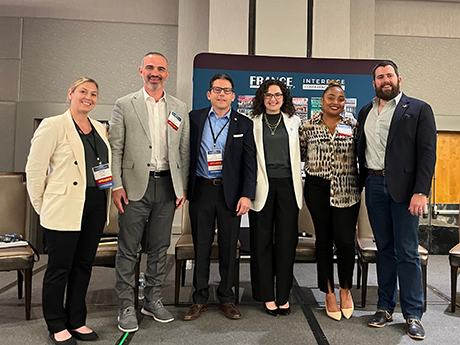
In addition to Hunter and Hundley, the panel, titled “Design, Construction & Operations: Trends in Affordable Housing,” included Margo Jamison, senior architect with GVSA; Katherine Uhrin, associate principal at Niles Bolton Associates; Edward Tekin, founder and CEO of Steel Tech USA; and Khadijah Cole, market development director at Georgia Power. Hunter served as the panel moderator.
The LIHTC program is the primary engine for subsidized affordable housing in the U.S. It accounts for approximately 90 percent of all newly created and rehabilitated affordable rental housing executed today, according to the federal government. The One Big Beautiful Bill Act, signed into law on July 4, 2025, delivered the biggest expansion of the LIHTC program in over two decades and will help finance 1.2 million additional affordable housing units over the next 10 years, say analysts.
But issues like community opposition, high construction costs and a choppy U.S. economy mean that constructing affordable housing remains a complex and challenging endeavor. As a result, architects have become increasingly creative with their designs to minimize costs for their developers while maximizing comfort and affordability for their residents.
Sitting Down at the Table
The nature of affordable housing necessitates complex tax credits, heavy involvement from local and state governments, and the coordination of developers, architects, lenders and residents. To simplify the process, everyone needs to be at the table as early as possible in the project, the panelists agreed.
“What’s working is getting involved early so that you can do that [construction] analysis and see what’s going to work to help and look at the totality of savings,” said Hundley.
Since the pre-development cycle for LIHTC-funded projects takes anywhere from one to two years, elements are constantly in flux, Hundley points out. An endless number of problems can arise, and the solutions require patience, time, money and flexibility with different partners.
“There’s volatility,” said Hundley. “We understand that … but everybody has a little bit of risk in the game when it comes to affordable housing.”
That volatility means that architects are always prepared to redesign if partners shift, but it’s far more inefficient for everyone if they need to do so. They’d rather have everyone be on the same page.
“We’ll design all day, but we hate to have to redesign, which means we’re going to have to charge our client more money,” said Hundley.
Cost of Materials Plays a Big Factor
Determining which materials to use in a project is a continual review process for developers because of several factors, including cost. Residential construction materials have increased 39.1 percent since 2020, outpacing inflation, according to Novogradac, a tax consulting firm. High tariffs on steel and soft lumber have substantially contributed to this issue.
The fact that many affordable housing projects are built on unevenly shaped land parcels with difficult terrain often contributes to the decision on what materials to use. For example, modular housing typically requires flat land, which makes it very inflexible, according to Hunter.
For Uhrin, a primary concern on her most recent projects was the speed of construction. Uhrin was tasked to design a building using the volumetric modular method, an offsite construction technique where complete, three-dimensional room or space units are prefabricated in a controlled factory setting and then transported to the building site.
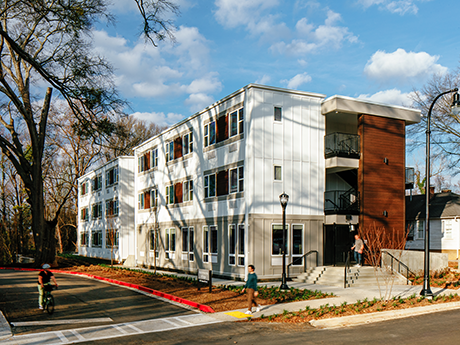
The completed project, Waterworks, features 100 units for homeless residents and is part of the City of Atlanta’s Rapid Housing Initiative.
Uhrin noted that the cost of using the modular method is on par with traditional stick-built affordable housing. But permitting for modular structures is much more extensive, requiring permission from the state level as well as the local level, which lengthens the process.
While waiting for the permits, however, the developer completed most of the buildings in the factory, according to Uhrin. Once the permits were approved, the developer was prepared to move the modules to the site and install them, reducing the construction time to just nine months and saving hundreds of thousands of dollars in insurance and labor costs.
Jamison, who leads GVSA’s affordable housing studio, is particularly excited about the potential of mass timber, an engineered wood product that is much stronger than the wood typically used in stick-built construction while also being light compared with concrete and steel construction, according to the Environment and Energy Study Institute.
Mass timber, which is more environmentally friendly because it traps carbon dioxide inside the building components, is more commonly used in European construction. European developers pioneered the technology in the 1990s. Mass timber construction began to gain traction with U.S. developers a decade ago, according to Balfour Beatty. With limited widespread adoption, the cost remains fairly high. But Jamison is optimistic about the potential of the material, citing the success of Campus 244, an office building in Dunwoody, Georgia, which had two stories of mass timber added on top without the need for modifying the foundation.
“I do think it’s a solution we should be excited about and be looking to utilize for trickier sites,” said Jamison. “We talk a lot about office conversion, but what if we’re building mass timber housing on top of offices? What if we’re doing mixed-use buildings that way, adding density, adding affordable housing in spaces that already have the infrastructure to support more density?”
Willis Towers Watson (rebranded as WTW), a British-American risk management and insurance brokerage firm, notes that both modular building and mass timber can also raise insurance costs for builders. That’s an important point given that low-income housing property insurance costs rose 287 percent between 2016 and 2024, according to Novogradac.
Tekin pointed out that using steel reduces insurance costs due to the non-combustible properties of steel as well as its resistance to environmental issues such as termites and mold. Additionally, Steel Tech has vertically integrated much of the process from engineering to installation, which Tekin claims has reduced the cost of steel framing by approximately 30 percent.
“When you start value engineering from the beginning, and when you do all the prefabrication in your own facility, and when you do the job site installation with your own team, that streamlined process now makes light gauge steel prefab framing beat lumber pricing,” said Tekin.
Building Quality, Sustainability Inextricably Linked
The panelists said they prioritize construction quality that minimizes the cost of maintenance while providing a high quality of life for tenants. Repairs and maintenance surpassed payroll as the biggest expense category for LIHTC properties in 2023 and 2024 as repair costs per unit rose more than $1,000 between 2016 and 2024, according to Novogradac.
For developers, construction quality and sustainability go hand-in-hand. While LIHTC-financed projects must meet sustainability standards in Georgia and other Southeastern states, many developers go further by adding features that help lower operating costs.
“Getting energy efficiency and lowering costs for your tenants and your own operations is a big key to that,” said Hundley when asked how to make projects more affordable. “A lot of the efficiencies that we are designing toward are already [tax credit incentives] and requirements you need for affordable housing in Georgia. So, a lot of those are pretty easy pickings.”
Cole of Georgia Power highlighted a variety of rebates available to property owners, including the Energy Assistance for Savings & Efficiency (EASE) program. An initiative of Georgia Power, EASE provides no-cost energy efficiency upgrades to qualifying low- to moderate-income residential customers. More specifically, Georgia Power assigns an approved contractor to complete up to $5,000 worth of energy-efficiency improvements per residential unit entirely for free.
“That can be anything from going from an all-gas property to an all-electric property,” Cole explained. “We also have some individual improvements like heat pump water heaters where you can go ahead and get rebates back for just converting your full property.”
If sustainability and lowered energy bills improve resident quality of life, so, too, does the property seamlessly integrating into the neighborhood. The developers are aware that constructing affordable housing that blends into a neighborhood’s overall look and feel might cost more, but it’s worth it to give their residents a sense of belonging in their new community.
“The more successful affordable housing just kind of disappears into the community,” said Hundley. “It’s designed with dignity instead of minimal compliance.”