

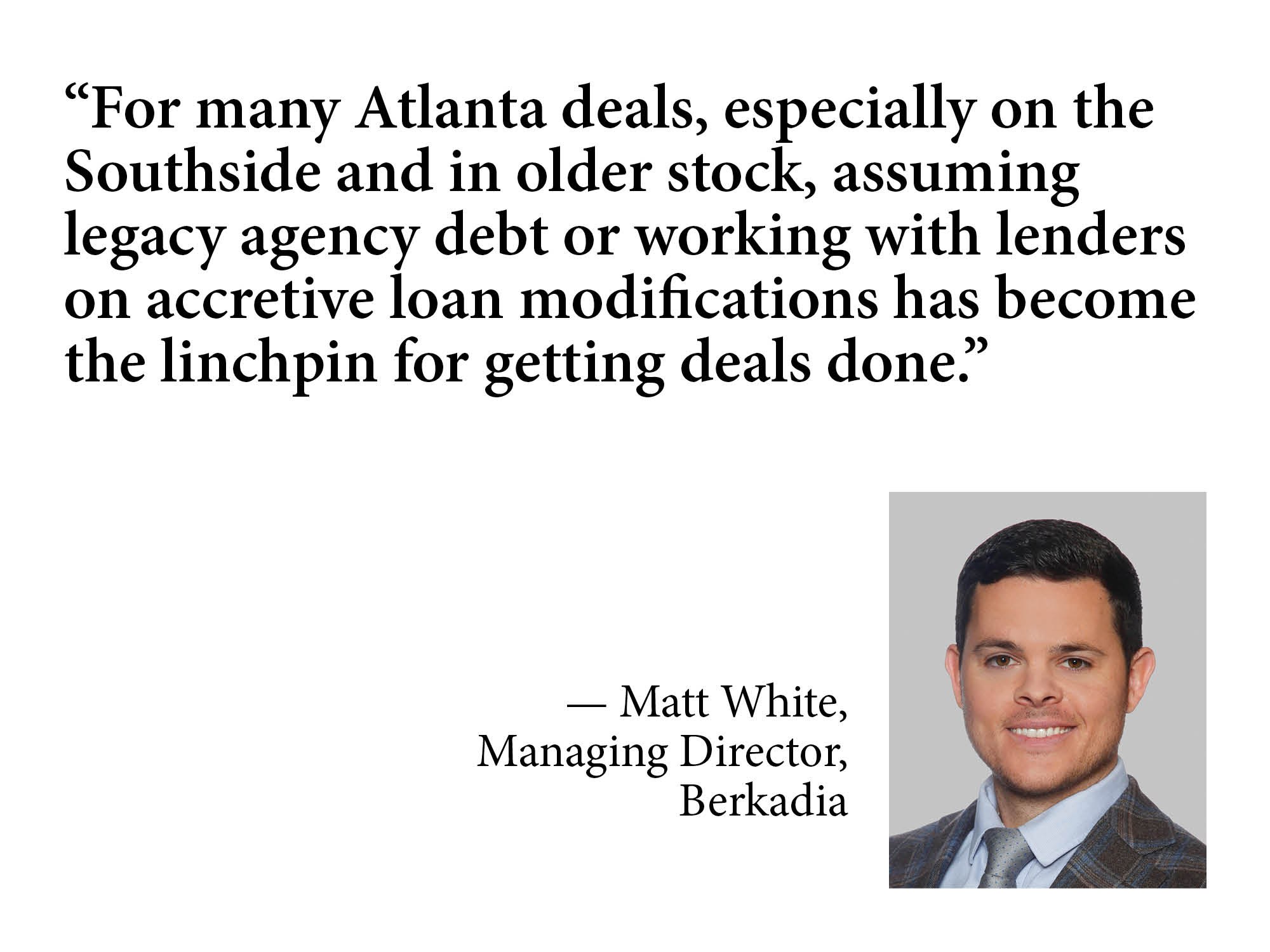
— By Matt White, managing director, Berkadia
Across Metro Atlanta, distress and loan assumptions are no longer edge cases — they’re driving a meaningful share of multifamily transaction activity and quietly resetting the market’s pricing benchmarks. Deals that can successfully navigate legacy debt structures, rising operating costs and shifting return expectations are revealing where true clearing values lie and which capital stacks still work in today’s environment.
The same forces driving distress in Dallas, Phoenix and Austin — floating-rate and bridge debt maturities, late-cycle construction and operating cost inflation — are present in Atlanta. But Atlanta’s deeper, more diversified demand profile and sophisticated buyer pool are helping the market work through distress more quickly and establish real, clear prices.
For many Atlanta deals, especially on the Southside and in older stock, assuming legacy agency debt or working with lenders on accretive loan modifications has become the linchpin for getting deals done, reducing borrowing costs by 100 to over 200 basis points relative to new debt, preserving higher leverage and more manageable equity checks and providing sellers with price support and buyers with greater certainty of execution.
Distress and Assumptions: The New Pricing Realities
Distress in value-add and workforce housing also matters beyond the capital markets, as this segment effectively represents Atlanta’s “affordable” housing stock. Distress in this category influences the quality of life for tenants when pressured owners defer maintenance and capital expenditures; the future of naturally occurring affordable housing, depending on whether new owners choose to stabilize and preserve it or re-underwrite to luxury; and market-wide pricing benchmarks, since these assets trade more frequently and serve as a primary barometer for multifamily risk/return in the metro.
Distress and assumptions are actively rewriting the pricing playbook in Atlanta, with a widening cap rate spread between well-capitalized assets with assumable, below-market debt and distressed, floating-rate or bridge-financed properties; distressed and assumption-driven sales establishing the new “floor” for values and informing lender and equity underwriting; and a shift toward structure-driven deals — assumptions and creative recapitalizations — and a flight to realistic business plans, sound basis and more conservative underwriting.
Berkadia’s Atlanta investment sales multifamily platform is sitting at the center of where the market is actually resetting. The team currently holds the number one market share for value-add and workforce housing transactions in metro Atlanta, the number one market share for value-add and workforce housing loan assumptions in the area and 100 percent market share for large, non-portfolio transactions on Atlanta’s Southside (300+ units, pre-2020 construction). They have sold the largest multifamily asset (700 units) and the largest agency assumption for a distressed asset in metro Atlanta, and in 2025 the team closed $768 million in production volume, across more than 6,000 units and 33 transactions.
__________________
This article was written in conjunction with Berkadia, a content partner of Multifamily & Affordable Housing Business.
Partner with Berkadia Special Situations and Berkadia Atlanta to develop divestment strategies that help you manage risk and recover capital.
For information on becoming a Multifamily & Affordable Housing Business content partner, contact us.