

Running a leasing and management office and running a mailroom are two different jobs. At many multifamily communities, one team is doing both. But manually processing an increasing volume of parcels can consume untold staff hours and pull people away from leasing, marketing and other priorities — driving up costs and dragging down the operational efficiency needed to maximize occupancy and protect NOI.
With last year’s slumping rent growth dampening operators’ revenue expectations, more multifamily owners are seeking help to turn package management from a labor-intensive cost center into a more manageable, efficient resident amenity that supports resident retention.
That’s according to Shelly Peterson, vice president of Smart Package Room. Deployed across multifamily, student housing and commercial properties nationwide, Smart Package Room is a scalable, all-in-one package management solution that automates package delivery and pickup using AI-powered computer vision technology.
Sponsored: How much are you spending on package management? Use the Cost & Labor Savings Calculator to find out.
“Our clients now are really wanting us to support them in achieving their best NOI,” Peterson says, describing operators’ desire to preserve net income by doubling down on customer service and resident retention, while striving to keep costs in check.
“We know that operators are managing with less staff, and in addition to all their other daily functions they have these constant interruptions to deal with packages,” she says. “They need a low-touch solution that removes that burden.”
Package Pain
How much of a burden do packages represent? Among Smart Package Room clients, the average community size is 370 units and the average daily package count is about 75.
Most properties receive daily bulk deliveries from several major carriers, perhaps three to five trucks in all. An erratic stream of drivers bearing one-off deliveries trickles in throughout the day, adding to the volume of packages that must be received and secured, and the recipient notified. Without a self-service system for pickup, a property team member must also retrieve each package for residents when they arrive to claim them.
“At a property without a package management solution in place, each package would take four to five touches to get to its recipient,” Peterson says. “If you extrapolate 75 packages a day with an average touch point of five minutes, that’s over six hours of the day.”
For a management team of two or three people, losing the equivalent of half of one employee’s working hours each day to package wrangling represents a substantial drain of labor and productivity.
Any assessment of package management costs should also consider the effect that unsatisfactory parcel retrieval experiences can exert on the property’s bottom line in the form of negative reviews, reputational damage and moveouts.
Landlords incur a series of expenses to backfill an apartment when a tenant departs. From lost rent to make-ready outlays, marketing and leasing commissions, resident turnover costs average $4,000 per unit, according to research by Zego, a Global Payments company.
By contrast, a package management system that residents grow to trust, confident that their deliveries will be secure and available when they are ready to retrieve them, contributes to the positive experiences that satisfy resident expectations and make them want to renew at the end of their lease term. By the same token, residents are more likely to describe the property positively on social media when they are consistently satisfied with their interactions with the package management system. This can help to attract renters to any available units.
“Resident retention is driven by experience. We deliver that through a seamless package service that meets expectations every time — while giving owners back valuable time.”
Solutions that scale
Efficient package management systems minimize the property team’s involvement. Some options secure delivered items in steel lockers, which the recipient accesses with a key or access code. Drawbacks include cost and the literal inflexibility of steel; installations require a permanent dedication of space for a fixed number of lockers.
Seasonal surges in shipping — such as Black Friday and Amazon Prime Day, or move-in week at student housing communities — can lead to overruns. When all lockers are full, the property management must find a closet, office or other space to secure overflows. Alternatively, the operator may install more lockers to handle surges, replacing rentable or amenity space with single-purpose infrastructure for package management.
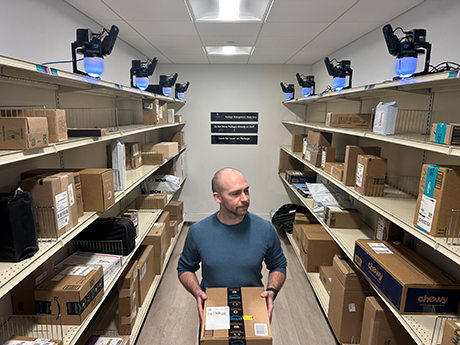
Smart Package Room’s solution provides security via a single controlled entry point and a “digital breadcrumb trail” of access and movement tracking within the space, greatly reducing the property owner’s infrastructure and installation costs.
Delivery drivers or staff enter the package room and deposit items on simple shelves or in designated areas for dry cleaning, refrigerated items or oversized goods. Open formats allow close placements and easy reconfigurations to accommodate seasonal surges and volume growth.
Advanced visual scanners capture label information and log the position of each package, automatically notifying the resident with a photo of the item and a QR code for pickup at any time. Retrieval is self-service with audible instructions and laser guidance that directs the resident to their package. The average pickup time is 10 seconds.
“We want to get our clients out of the package business,” Peterson says. “After implementation and onboarding in our solution, we want them having conversations, engaging with the residents and serving their community, rather than reactively dealing with package issues.”
— By Matt Hudgins. This article was written in conjunction with Smart Package Room, a content partner of Multifamily & Affordable Housing Business.
For information on becoming a Multifamily & Affordable Housing Business content partner, contact us.